
TheInfoWire.com — Middle East Affairs
Yemen’s Houthi movement has declared a naval blockade against Saudi Arabia.
How We Got Here
The trigger was astonishingly small: a flight between Tehran and Sanaa in early July. The Houthis suspect Saudi Arabia of trying to block the plane from landing, and when Sanaa’s airport was struck days later, the group pointed the finger at Riyadh — even though Yemen’s own internationally recognised government claimed responsibility for the strike, saying it was meant to stop the Iranian flight.
The Houthis retaliated with a missile strike on a Saudi airport, which Saudi security intercepted. From there, things escalated quickly. Within days, the group moved from threats to action, announcing a full maritime blockade and framing it as retribution for what they describe as Saudi Arabia’s own siege on Yemen.
Why the Houthis Are Doing This
This isn’t purely a Yemen-Saudi dispute — it’s tangled up in a much bigger regional struggle. Iran’s conflict with the US and Israel has already disrupted oil shipping through the Strait of Hormuz. By activating the Houthis against Saudi Arabia, Iran effectively opens a second pressure point without firing a shot itself. It’s a classic proxy strategy extending Iran’s reach into the Red Sea while keeping its own hands technically clean.
The Houthis have also shown before that they’re capable of launching this kind of threat. During the Gaza war, they spent months attacking commercial vessels in the same waters, forcing shipping companies to abandon the route entirely until a ceasefire calmed things down last year. That history is exactly why this new blockade announcement is being taken seriously rather than dismissed as bluster.
What It Means for Oil Prices
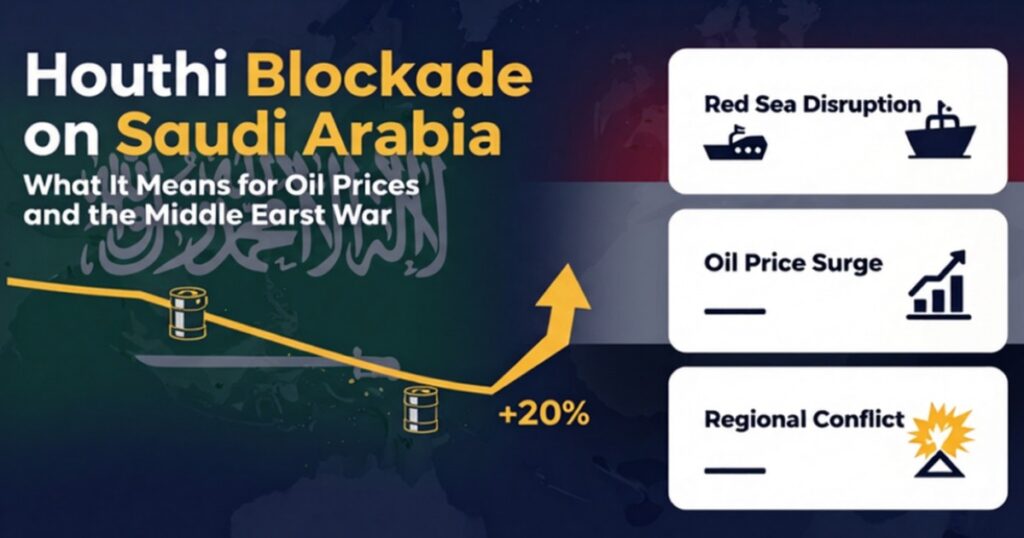
This is the point where a regional dispute turns into a global economic concern. Bab el-Mandeb, the strait separating Yemen from the Horn of Africa, isn’t just a local waterway — it’s one of the busiest and most economically vital shipping lanes on Earth, moving goods worth close to a trillion dollars every year
Saudi Arabia had actually been counting on this route as a backup plan while Hormuz remained under threat. The Houthi blockade threatens to cut off that fallback option too, putting pressure specifically on Saudi crude exports from the Red Sea port of Yanbu.
Initial market reaction was fairly restrained, with only a small uptick in oil prices — but analysts see that as just the first ripple, not the full story. Should the blockade genuinely disrupt shipping traffic, global oil supply could face a real squeeze, potentially driving prices past the $100-a-barrel mark. And in the most severe case — both Hormuz and Bab el-Mandeb blocked at once — some analysts project prices could reach $150 to $200 a barrel, a level the world has never actually experienced. Shippers do have alternatives: rerouting around Africa’s Cape of Good Hope, or leaning on pipeline capacity instead of sea routes. But both options are slower, costlier, and limited in how much oil they can actually move.
The Bigger Picture
Diplomatic efforts haven’t stopped entirely; mediators are reportedly still working behind the scenes to defuse the situation. But for now, a dispute that began with a single disputed flight has turned into a threat against one of the world’s most important trade arteries, with consequences that could reach far beyond Yemen and Saudi Arabia.
TheInfoWire.com will keep following this story as it develops.